


.png)
Well, it’s that time of year again for Mrs. B, when the world gets darker and less joyful. I’m not talking about the end of summer, but rather the end of the professional cycling season. From a family of serious riders back home in Barcelona, she is a diehard fan of the sport. From early May to mid-September, she’s utterly glued to all the grand tours and minor races across Europe.
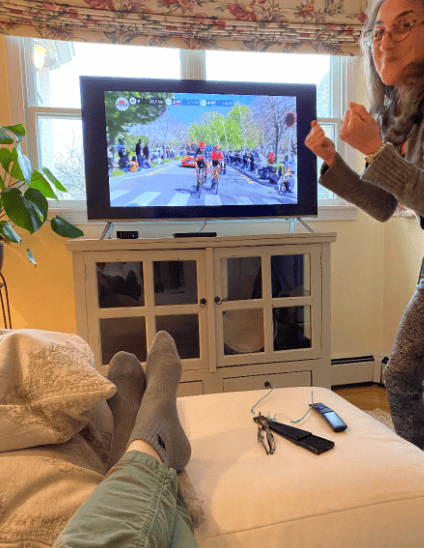
Even though I don’t completely understand it, I do my best to keep a good attitude. Each morning she shares fresh, thrilling headlines from the sport that sounds to me more or less like, “Tövias Fønkenmüllenfunchmausen, who rides for [Estonian toothpaste company-sponsored team] Skivnhflaffen, has taken the Paisley Jersey, which is awarded to the rider between 23 and 25 who most consistently calls his mother!”
And I rarely complain, despite the fact that to watch the “Tour of Blechenmilt” requires downloading a Nigerian VPN connected to a Belarusian crypto app that I’m pretty sure has infected all of our connected devices with viruses. The cost of watching cycling is our children’s disappearing inheritance, which is getting syphoned off by a guy named Vlad in Minsk. Sorry, kids.
It’s okay, though, because I’ve always told our kids that human dignity comes from “earned success,” not unearned wealth, and encouraged them to be entrepreneurial. This gave them the initiative to keep an eye out for opportunities—some better than others. For example, back in 6th grade, after a dinnertime lecture from me on the free enterprise system, our middle son cooked up an ingenious plan to exploit a market failure at his school. It turns out that the cafeteria was selling delicious breakfast sandwiches for $1 each, but had a limited supply of 50 sandwiches per day. The boys lined up every day to get them. Our son took $50 from his piggy bank, got in line an hour early, bought the entire supply, and then began selling them to the boys behind him in line—for $2 each.
The school administration quickly got wind of the scheme and shut it down, leaving him with 50 rapidly cooling sandwiches in his backpack and a lot less spending money. This provoked howls of righteous outrage at home. “The tyranny of big government!” he called it. “Arbitrary and capricious regulation,” his older brother chimed in. I beamed with pride.
And in fact, the kids went on to be true entrepreneurs in short order, in what really counts the most: love. For example, both the boys had “start-up marriages” in their early twenties. And that’s my subject today.

Many people have asked me when the optimal age to marry is. Social scientists have studied this. For example, a researcher at the Institute for Family Studies estimated that the optimal age for getting hitched is 28 to 32 for both partners.1 This is the “sweet spot,” where divorce within the first five years of marriage is lowest.
Naturally, this finding might provoke angst among those who would like to be married but have passed the “ideal” window. But it shouldn’t. By looking at why the 28-to-32 bracket appears to work best, we might be able to re-create those conditions for almost any age—even 72. People who have passed the 28-to-32 window can benefit by resisting the characteristics of, to continue the business analogy, a corporate merger. Here are three practices everyone looking for love can keep in mind.
- Make it a start-up. Corporate mergers struggle when financial integration is burdensome. The same goes for a marriage: Maintaining separate finances lowers the chances of success. Research shows that when couples pool their funds and learn to work together on saving and spending, they have higher relationship satisfaction and are less likely to split up.2 Even if you don’t start out this way and have to move gradually, financial integration should be your objective. This will give your partnership a start-up ethos.
- Forget 50–50. I have heard older couples say that they plan to split responsibilities and financial obligations equally; this might sound good in theory, but it’s not a realistic aspiration. Worse, splitting things equally militates against one of the most important elements of love: generosity—a willingness to give more than your share in a spirit of abundance, because giving to someone you care for is pleasurable in itself. Researchers have found that men and women who show the highest generosity toward their partner are most likely to say that they’re “very happy” in their marriage.3
- Take a risk. The percentage of couples with a “prenup” has increased fivefold since 2010. A prenup might sound like simple prudence, but it is worth considering the asymmetric economic power dynamic that it can wire into the marriage. Some scholars have argued that this bodes ill for the partnership’s success, much as asymmetric economic power between two companies makes a merger difficult.4
- Learn about love. A short while back, I covered how to find love on Office Hours. If you’re hungry for more tips on how to find your beloved, no matter your age, this is a good place to start.
But beyond all this, here’s the big thing to remember: Whether you are 22 or 72, the best approach to a successful love start-up is one in which co-founders see each other as equals and walk confidently into the future together in a spirit of generous, golden collaboration.
See you next week,

P.S. Months ago, I created the Meaning Membership. This is a community of peers who are eager to find more meaning in life, and each month, I go live to discuss a big topic with the science and ancient wisdom top of mind. Our upcoming session, on September 21, is titled The Alchemy of Pain: Don’t Waste Your Suffering. If that sounds interesting to you, please do consider joining our merry band of meaning seekers.
References
[1] Wolfinger, N. H. (2015, July 21). Replicating the Goldilocks Theory of Marriage and Divorce. Institute for Family Studies.
[2] Gladstone, J. J., Garbinsky, E. N., & Mogilner, C. (2022). Pooling finances and relationship satisfaction. Journal of Personality and Social Psychology, 123(6), 1293–1314.
[3] Parker-Pope, T. (2011, December 8). The Generous Marriage. The New York Times.
[4] Marguiles, S. (2003). The psychology of prenuptial agreements. The Journal of Psychiatry & Law, 31, 415.
.png)
.png)