


.png)
Over here at Team Happiness, my colleagues and I are looking at the travel grid for the coming year. So many nights ahead for me in Courtyard Marriotts! All those loyalty points will get me…um…well, more nights in Courtyard Marriotts. It’s like the old joke about life: “What’s first prize in a pie-eating contest? Answer: Pie.” (Life advice: I hope you like pie.)
We were discussing when to schedule my next speaking tour in India, where I love going every year. Well, I mostly love it—last time I went, we had a little mishap. After a conference in Dharamshala with His Holiness the Dalai Lama, my colleagues and I grabbed the only flight down to Delhi, on an aging turboprop operated by an airline called SpiceJet. Their motto—I am not kidding here—is: “Red. Hot. Spicy.” Maybe it’s just me, but these are NOT the precise characteristics I’m looking for in air travel.
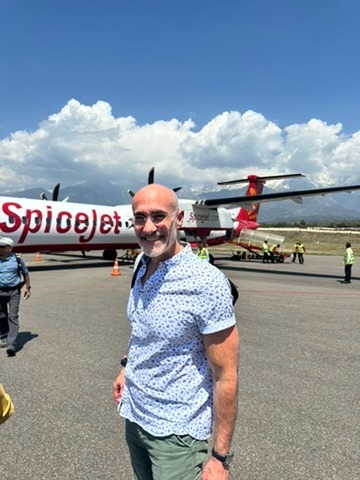
The airline lived down to its weird motto, it turned out. At 13,000 feet, we were notified by the pilot that we would be making an emergency landing in a city below us on the Pakistani border, and very far from Delhi. No further explanation was forthcoming, as the flight attendants took their seats and stared straight ahead with an ashen expression. The problem was soon evident, though: A glance out the left window revealed a propeller that was lazily rotating backwards. Meanwhile, the right propeller was making a sound kind of like, well, perhaps someone playing a bassoon filled with bees while being dragged behind a dirt bike with no muffler.
Anyhoo, yada, yada, yada, I am still alive to recount the tale. Getting home took a few twists and turns, including quality time in several airports and a shared hotel stay with a monk from the flight who cleaned out my minibar. Arriving a day late, Mrs. B had choice words about my misadventure. She didn’t see the humor in it at all, I’m sad to say, and declared that the fault was all mine for choosing an airline that sounds tastier than it does safe. FINE. We agreed to disagree.
She was right, of course. (She reads this newsletter, I think.) But it actually isn’t true that danger per se is bad for happiness. Sure, the plane-crashy kind of danger isn’t so great. But in fact, you might find that a little bit of danger of certain types can make your life more fun and interesting. That’s our topic today.
Risk taking for its own sake can be good or bad. On the one hand, some extreme athletes describe the experience as sacred, or beyond words.1 They might even enter a “flow state,” an effortless condition of feeling both completely immersed and totally in control.2
On the other hand, risk taking can be a sign of trouble. For example, people who find normal activities under-stimulating might look to dangerous pastimes as sources of stronger sensations, even at the risk of self-harm. These people are known as “high sensation-seekers,” and they tend to have low amygdala reactivity, meaning that their fight-or-flight response is muted.3 They also exhibit blunted stress and startle responses, and underestimate the likelihood of bad outcomes. People with low amygdala activity are more likely than others not just to jump from airplanes or tease dangerous animals but also to engage in dangerous substance use, such as binge drinking.4
Done right, though, engaging in something a bit dangerous can enhance your courage and raise your happiness. Done wrong, it’s just stupid, and you might get hurt or killed. Here are three guidelines to apply this rubric to your own life.
- Do something you fear. Maybe it’s going back to school or leaving a city where you have lived your whole life. If it sounds simultaneously possible and terrifying, you’ll know you’ve found the right thing.
- Envision bravery—but not recklessness. The first step is to envision yourself doing the thing that scares you, and how you will feel about yourself if you take that risk. This will get you used to the idea, and make it less daunting.5 Think clearly, however—using your conscious brain to reason, not just your amygdala to feel. In some cases, the odds of failure are so high and the consequences so dire that the act is reckless. If I had charged into the cockpit to pilot the SpiceJet flight to safety, things would have turned out a lot worse.
- Make a sensible plan and follow it. If you want to raise your happiness by taking a risk, you need to do it right, and not just by acting on impulse. In fact, the research shows that happiness and impulsivity are largely incompatible.6 Furthermore, making a plan allows you to savor the person you want to become—a person who does a hard thing of his or her own volition, precisely because it is hard.
Want to further explore the magic of a little danger? If so, I explored this topic on an episode of my podcast, Office Hours.
Until next week, make sure to keep it red, hot, and spicy,
Arthur


P.S.—There is a digital version of me trained on millions of words of my writing—use it to go deeper on this week’s topic, or on anything about building a happier life. Don’t know where to start? Try this prompt: Can taking risks actually build courage over time? Try it here.
References
[1] Brymer, E., & Schweitzer, R. D. (2017). Evoking the ineffable: The phenomenology of extreme sports. Psychology of Consciousness: Theory, Research, and Practice, 4(1), 63–74.
[2] Boudreau, P., Mackenzie, S. H., & Hodge, K. (2020). Flow states in adventure recreation: A systematic review and thematic synthesis. Psychology of Sport and Exercise, 46, 101611.
[3] Mujica-Parodi, L. R., Carlson, J. M., Cha 차지욱, J., & Rubin, D. (2014). The fine line between 'brave' and 'reckless': amygdala reactivity and regulation predict recognition of risk. NeuroImage, 103, 1–9.
[4] Crane, N. A., Gorka, S. M., Phan, K. L., & Childs, E. (2018). Amygdala-orbitofrontal functional connectivity mediates the relationship between sensation seeking and alcohol use among binge-drinking adults. Drug and alcohol dependence, 192, 208–214.
[5] Brooks, A. (2021). Go Ahead and Fail. The Atlantic.
[6] Garaigordobil M (2015) Predictor variables of happiness and its connection with risk and protective factors for health. Frontiers of Psychology, 6,1176.
.png)
.png)