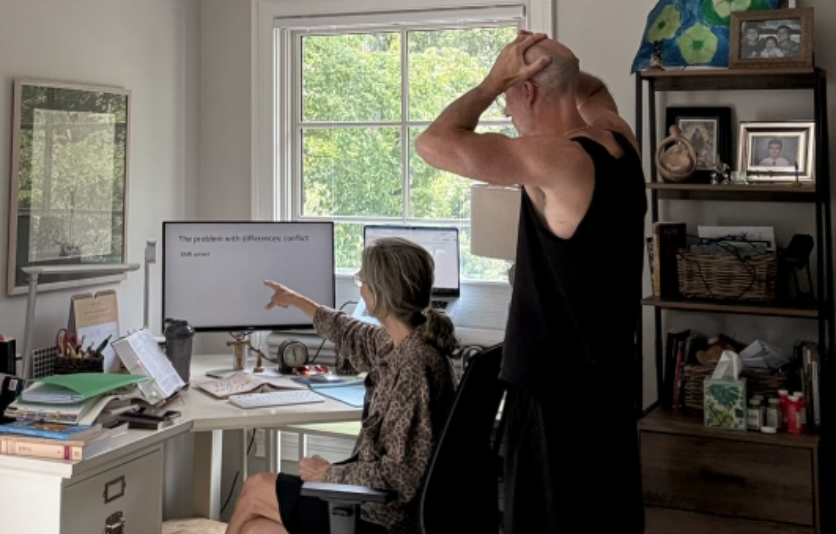
I hope you and your family had a lovely week and are set for a fun and relaxing weekend. I had a nice time out on the road this last week, with media in New York (the TODAY show and CBS Mornings), Connecticut (a public lecture at Fairfield University), and Florida (Florida College in Tampa). This Sunday, Mrs. B and I will give a talk together to a large group of young adults at Old Saint Patrick’s Basilica in New York, titled, “Falling in love and staying in love.”
We are doing more and more of these events around the country and enjoying it a lot, though we do have different work styles and have to be patient with each other as we prepare our presentations.

Just as people often are surprised to learn that I am not naturally an overly-happy person—I study it to get better at it myself!—they sometimes find it surprising when Mrs. B and I tell people we have strife like any other couple. But of course, we do; mating in captivity always poses challenges. Plus, well, Mrs. B is Spanish, and thus considers arguing a form of intimacy.
And then there are the children. In many families with kids at home, the clever little devils are very adroit at setting the old folks against each other to get what they want. When our kids were young, however, we had a parental solidarity pact from the get-go: us against them. We called it The Wall. If one of the kids came to me complaining that mom had said that the sky was green, I said I thought she was right. Much like my beloved Seattle Seahawks, Team Parents vanquished Team Progeny every time through solid defense.
But this often caused conflict with the kids themselves. Once, when our oldest was in high school, he became aggrieved at a decision of mine—I don’t remember what—that he felt was arbitrary, capricious, and utterly unjust. So he appealed to his mother. He is a smart and reasonable person, and I suspect his position had merit; but no matter, his appeal went exactly nowhere. The Wall was The Wall. Incensed, he turned to his five years of Latin studies and shouted, “Sic semper tyrannis!” and stomped off to his room.
That’s “death to tyrants” to all of you goof-offs who, like me, took woodshop instead of Latin back in school. Unfortunately, that’s also what John Wilkes Booth cried after shooting Lincoln. But we were pretty confident he wasn’t referring to any of that unpleasantness and saw it instead as evidence that his private school tuition was paying off. Now there’s some highfalutin’ teenage rebellion, don’t you think? So much higher quality than my own rebellion at that age, which mostly consisted of smoking cigarettes out behind the garage and risking hepatitis by getting my ear pierced in a dorm room by a sullen and mysterious girl who went by the single initial “R.”
But, you might ask, what about conflict with the kids after they are grown up? That’s a different kettle of fish—and our subject today.
Even in the best of situations, tension between adult generations in a family is normal. One common source of tension stems from misalignment between how adult children and their parents view their relationship and the roles that they each play—in other words, mismatched expectations. Parents may think that the relationship is more harmonious and enjoyable than their adult kids think it is, while grown children may view the benefit of the bond in terms of exchanges of assistance.1
Taking action is important. I recommend employing the following three strategies, which curtail three common, harmful patterns.
- Don’t try to read minds. As the years go by, many families fall into a tendency to assume that everyone understands one another without saying anything. This is an invitation for miscommunication. Evidence shows that it’s best to have a clear family policy of speaking for yourself and listening to others.2 One way to do this is with regular family meetings, where each of you can air issues that are on your mind before they fester into a major problem or misunderstanding.
- Live your life, but don’t ask them to change their values. Estrangement within families is a tragedy—perhaps inevitable in cases of abuse, but avoidable in so many clashes of pride. You have to decide yourself whether a schism is warranted, but as common sense and the evidence suggest, aging parents are likelier to accept lifestyle choices that they disagree with than accept their kids telling them that their values are wrong, which they might perceive as a personal rejection.3
- Don’t treat your family like emotional ATMs. When people treat their family as a one-way valve of help and advice, visits and calls become tiresome, repetitive interviews instead of conversations. My belief is that this stems from stunted development in the relationship. For example, perhaps mom and dad still treat you like a youngster; meanwhile, you rarely or never ask about their lives or take a true human interest in them. Research shows that the relationship can be greatly enhanced when adult children and their parents treat each other as individuals with past histories and limitations; in other words, as peers.4
If your relationship with your parents or adult kids is difficult, working to improve it might feel like a lost cause. But giving up would almost certainly be a mistake, because “those people” are either your past or future self. As a young man, I thought I was quite different from my father; now I hear his voice almost every time I open my mouth. I suspect my oldest son, now the father of two sons himself, feels the same.
Until next week, post hoc, ergo propter hoc…oh to heck with it—back to woodshop for me,
Arthur

References
[1] Xu, W., Zhang, K., & Wang, F. (2022). The psychological mechanisms underlying Solomon’s paradox: Impact of mood and self-transcendence. Frontiers in psychology, 13, 901012.
[2] Khazan, O. (2016). Why Self-Compassion Works Better Than Self-Esteem. The Atlantic.
[3] Wray, L.D. & Stone, E.R. (2005). The role of self-esteem and anxiety in decision making for self versus others in relationships. Journal of Behavioral Decision Making, 18(2), 125-144.
[4] Batteux, E., Ferguson, E., Tunney, R.J. (2019). Do our risk preferences change when we make decisions for otherS? A meta-analysis of self-other differences in decisions involving risk. Plos One.
[5] Eskreis-Wrinkler, L., Fishbach, A., DUckworth, A.L. (2018). Dear Abby: Should I Give Advice or Receive It?. Psychological Science, 29(11), 1797-1806.
[6] Grossmann, I., Dorfman, A., Oakes, H., Santos, H. C., Vohs, K. D., & Scholer, A. A. (2021). Training for Wisdom: The Distanced-Self-Reflection Diary Method. Psychological Science, 32(3), 381-394.