


.avif)
This year, Mrs. B and I will celebrate 35 years together. As she will tell you, though, it has felt like ten minutes—underwater. Ha! Ha! (Imagine living with a Catskills insult comic from the 1950s, except female and Spanish, and you get the idea of what my marriage is like.)
Anyhoo, in the spirit of love and one-liners, Ester and I will be leading a retreat in Santa Fe, New Mexico, from June 19-22 in partnership with MEA. It is called The Meaning of Us, and it’s meant for any couple who wants to grow in deeper union and understanding of one another. Spots are nearly full, so I hope you’ll consider rounding out our group—you can learn more here.
A lot of insights from behavioral science come from our understanding of human evolution. For example, heterosexual females during the middle Pleistocene were attracted to resource-acquisition cues in males that would have been life-or-death for themselves and their offspring, such as physical prowess for hunting buffalo, and ambition to rise in the hierarchy of their band of hunters and gatherers. Today, that same tendency is manifest in an attraction to status, ambition, wealth, physical fitness, and good health.¹
But this leads to a personal puzzle: When Mrs. B and I met, suffice it to say that I wasn’t her only option. She would regularly receive marriage proposals shouted from moving cars. My attraction to her was a no-brainer.
Her attraction to me, however, was less obvious. I had zero dollars in my bank account and, working as a classical musician, was barely making rent. I was also 6’2” and 142 pounds—basically, a walking skeleton subsisting on cigarettes and coffee. In other words, I was hardly a robust specimen, evolutionarily.
Except! Researchers have found that women also regard high creativity in men as attractive, perhaps because this acts as a cue for intelligence and, therefore, future resources.² Apparently, playing the French horn well can stimulate a prospective mate’s limbic system to sense that someone might have a path to good repute and financial stability at some point in the future. (I stimulated her father’s limbic system less favorably.)
Once a couple is past the early stages of romance, however, attraction starts to change. Scholars have shown that, with the passage of time, the physical attractiveness of mates becomes less important to men, and the resource cues are less important for women.³ What does become more important over time, for both sexes, are two personality traits: openness and mutual trust. Indeed, other things matter more, too: humor, enthusiasm, and validation—understanding and accepting each other’s feelings and perspectives—are especially important.
Happy long-term couples also have high levels of fondness and respect for each other.⁴
So, with all this in mind, we can deduce a few rules for growing old and happy with your beloved.
- Don’t chase what used to be attractive. Many men—who, when young, knew that their mate valued resources—get older and spend their days chasing more and more of the world’s rewards to stay attractive. But as the data above show, your mate’s preferences have probably changed: She just wants you.
- Bring home positivity. A toxic habit that plagues many marriages is bringing all of one’s negative emotions home because that is where it feels safe to express them. The result is that partners impose a deep negative burden on the one relationship that should bring them the most joy. But being positive does not occur spontaneously. You must resolve to bring your happiness home, not just your unhappiness, and endeavor to share it. One easy rule: When you get home from work, ask your beloved the best part about his or her day.
- Grow in spirit—together. Many long-term couples with a spiritual or religious bent describe their relationship as something like an antenna to the divine, an effect that becomes more powerful over time. This is certainly true for Mrs. B and me. In fact, as I’ve long said, she is my spiritual guru. And when I’m with her, I feel closer to God.
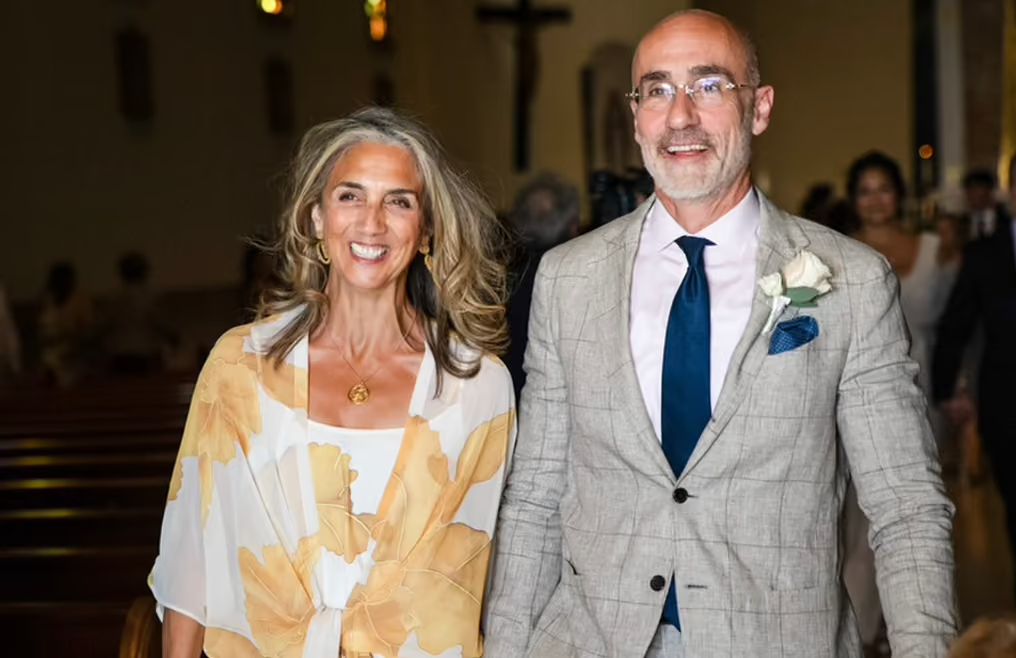
She still gets those proposals. I am still a skeleton, but now also a bald one.
With love from both of us,
Arthur

P.S. - One other opportunity you might find interesting. My team is hosting a different retreat from the one I mentioned above. It covers my new book, The Meaning of Your Life, at MEA’s gorgeous ranch in Santa Fe, New Mexico. It runs from June 14-19. Plus, I’ll join you in-person on the final day! If you’d like an immersive experience in a beautiful setting—full of lots of learning and growth—you can secure your spot here.
References
[1] Buss, D. M. (1989). Sex differences in human mate preferences: Evolutionary hypotheses tested in 37 cultures. Behavioral and brain sciences, 12(1), 1-14.
[2] Watkins, C. D. (2017). Creating beauty: creativity compensates for low physical attractiveness when individuals assess the attractiveness of social and romantic partners. Royal Society Open Science, 4(4).
[3] Whyte, S., Brooks, R. C., Chan, H. F., & Torgler, B. (2021). Sex differences in sexual attraction for aesthetics, resources and personality across age. PloS one, 16(5), e0250151.
[4] Shapiro, A. F., Gottman, J. M., & Carrere, S. (2000). The baby and the marriage: identifying factors that buffer against decline in marital satisfaction after the first baby arrives. Journal of family psychology, 14(1), 59.
.png)
.png)