


.avif)
I hope summer is giving you a bit of time away with your loved ones, whether it’s flying off to an exotic location or camping in the great outdoors.

It’s busier than ever here in the Brooks household, but in a good way. In addition to my ordinary weekly travels hither and yon (and then back again to hither), Mrs. B and I have a lot of public speaking together this summer. As you read this, we will be leading a couples retreat in Santa Fe. From there it’s on to Spain (Mrs. B’s native land) for a bunch of talks and podcasts together on love and happiness. This has particular significance because we married in Barcelona almost 35 years ago.
There has been so much change in our lives since then: We now have 3 grown kids and 4 grandkids; I’ve had 4 completely different careers; we’ve made 20 moves together (not kidding) since entering the Witness Protection Program (just kidding); and I have gone completely bald (not kidding, ha ha <sob>). Over all these years, our love has never wavered.
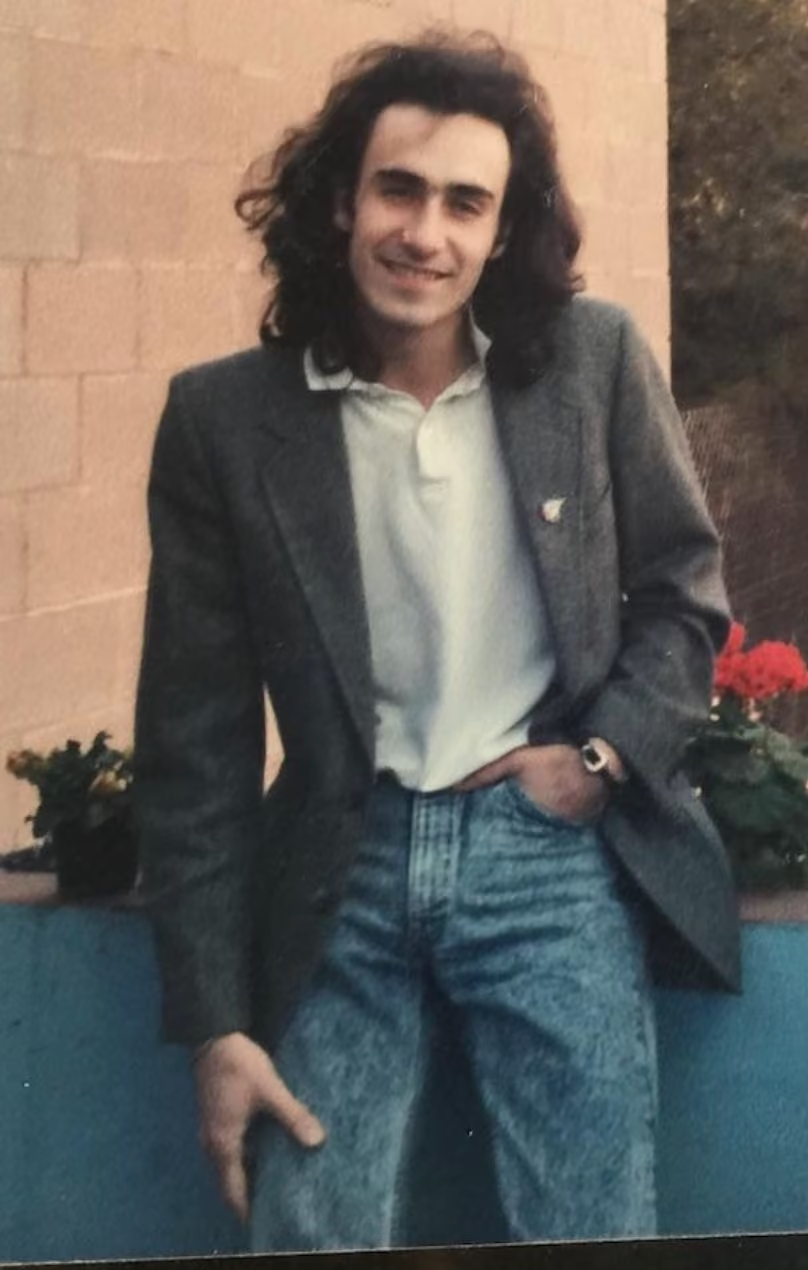
Back in the days that that photo was taken, there were still a few hippies here and there—looks like maybe I was one of them, doesn’t it? A common philosophy from that time was: If it feels good, do it! That turned out to be pretty stupid, in general. But it is still arguably better than the reverse, which is a de facto refrain for a lot of young adults today:
If it feels bad, make it stop!
But just as pursuing good feelings all the time can ruin your life, so can spending your energy trying to make bad feelings stop. That’s our topic today.
Emotional distress baffles us because we make the assumption that ailments are purely binary: You either have them or you don’t (like my hair, which I once had, and now do not). When we make such binary assumptions in our emotional life—“I have anxiety”—the costs are high. Instead of treating your anxiety like a dial that you might be able to turn down, you treat it like a switch to turn off.
This is the wrong way to understand our emotional lives. To begin with, some levels of stress and sadness are completely normal—even beneficial. For example, let’s say that, hypothetically, there might be a homicidal circus clown named Victor McStranglyhands hiding in your bedroom closet, just waiting for you to drift off to sleep. That thought should keep you awake. Even the simple suggestion made as a joke might do so. Tonight.
Negative emotions are a natural reaction to adverse events in life, a response that evolved to help us behave in useful, functional ways. True, these emotions can be exaggerated or maladapted, but everyone will have good reasons to feel stress, which helps us react to an event with focus and energy when needed, just as we respond with appropriate sadness when we experience a significant disappointment after a loss—even a loss as trivial as that of one’s hair.
The point is that feeling discomfort does not mean you are broken. You might instead be emotionally healthy but coping with ordinary pressures, a period of change, or Victor. No matter what, here are three things to remember, especially in your lower moments:
- We are all anxious and sad. Everyone suffers and suffering is part of the world. But forgetting this is easy when you’re told that you have a specific mental condition, and when you feel isolated and alone in your pain. You are not defective simply for feeling distress. You are human.
- The goal is not to eradicate suffering. It is normal and healthy to want relief from your suffering, but futile and dangerous to try to eradicate all of your pain. Think of it this way: When you have a headache, you want a Tylenol to take the edge off, but not narcotics strong enough to numb you completely. Emotional self-management—through meditation or prayer, or with the help of therapy—is like Tylenol, so that you can regain more comfort and control.
- Your happiness requires unhappiness. Consider Psalm 118:24: “This is the day the Lord has made. We will rejoice and be glad in it.” As a young man, I read this verse and gave thanks for the positive, happy things in my life. Today, I realize this was too narrow a reading. The psalmist is not saying “Be grateful for the fun stuff ” but rather “Be grateful for all of it.” That means both the fun parts I want and the hard parts I need, so that I stay alert, mourn loss, learn, and grow. Except for Victor.
See you next week, and—wait, was that the closet door opening?
Arthur

P.S. People keep asking how they can use The Happiness Scale to help others, whether that’s clients or simply the people in their own lives. So my team is building a certification to train you to do exactly that. The 2-day live-facilitated cohort opens in September, and you can join the interest list here if you’d like to be among the first to know.
.png)
.avif)