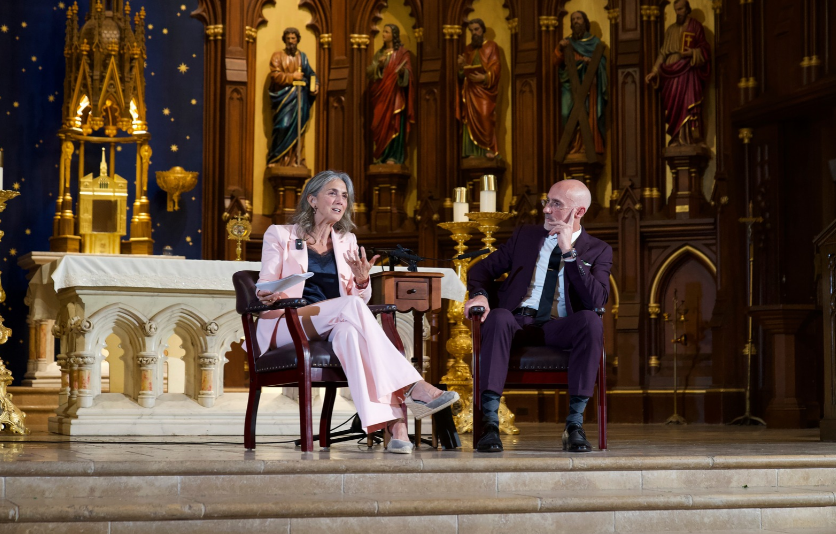
I hope you and your family had a lovely week. I am happy to report that I have successfully bamboozled Mrs. B into sharing some of my Road WarriorTM lifestyle, and this week had two events together, titled “Falling in Love and Staying in Love.” On Sunday we spoke at Old Saint Patrick’s Basilica in New York. Tonight (if you are reading this on Friday), we will be appearing at the University of Virginia. Between these events, I spoke at Will Guidara’s Welcome Conference at Lincoln Center, the annual conference of the National Association for College Admission Counseling, and at the University of St. Thomas in Saint Paul, Minnesota. I also recorded some episodes of my podcast and taught my executive education class at Vanderbilt. It’s been a fun and busy week.


If you have followed my work for a while, you know I give a lot of science-based advice on health and well-being. I am a maniac for evidence-based physical (and metaphysical) fitness. And fortunately, at the tender age of 62, I have mostly been able to follow that advice in my own life. My lifting is scientific, my macros are dialed, and my spiritual life is on point.
There’s still one bad habit I just can’t seem to kick, however: the sweets. I know how bad refined sugar is for your mind and body, and I advise others to get off the stuff. But sweets have a diabolical spell over me. I know you are thinking this is all very innocent and I am making a big deal out of nothing, right? Wrong. I have had blacked-out benders on candy. You want a story? FINE.
Once, on the way home from a late event, I stopped by a convenience store for a tasty snack, and picked out a family-sized box of Junior Mints, a perennial favorite. I finished about half the box before going to sleep. (Yes, I know that wrecks sleep architecture, thank you.) I placed the half-empty box on a windowsill above my bed. Well, during the night, I apparently got a hankering for a few more in my sleep—I am a sleepwalker and sleepeater—and somehow pulled them over into my bed. I woke up the next morning with a Junior Mint stuck to my forehead, smashed flat and wide as a silver dollar.
In the literature on addiction, this is known as a sentinel event. A cry for help; hitting rock bottom. “You are a sad, pathetic man,” I told myself in the bathroom mirror, as I washed my face. In that moment, I vowed to reform. But in the next, the old intrusive thoughts started: Had all the mints fallen into the bed? Were there just maybe a few left to eat? (There were. And I did.)
This is one area of life where I badly need to take my own advice. That’s our topic today.
It turns out that giving sage advice, but not taking it yourself, is an age-old problem. It’s a version of Solomon’s paradox, named after the wise king from the Bible who failed to live by his own wisdom, leading to the demise of his kingdom.1
Our self-mistrust could originate in problems of self-esteem or high anxiety.2 Scholars in 2005 showed that when people experience problems, they can give advice they personally don’t take.3 You might sagely tell a friend who has suffered a nasty breakup to “get back on the horse”; meanwhile, you un-sagely stay single and lonely for years out of a fear of being hurt again. Or you advise others to avoid sweets while, full of self-loathing, you can’t resist them yourself.
Many people also tolerate different levels of risk for others than they are willing to endure personally. In relationships, for example, we play it safe even as we advise others to go for broke.4 (“Go right back there and give her a piece of your mind!”). Solomon’s Paradox is pretty easy to understand. Solving it is a little harder, but according to the best studies, it’s possible if we take two steps.
- Don’t stop giving advice to others. One 2018 paper in the journal Psychological Science showed that people who struggle with goal achievement are more motivated when they dispense advice to others than when they receive it.5 Hearing yourself say wise, affirming things to others—even if you feel a bit hypocritical—can reinforce your own convictions and behavior.
- Then, treat your advice like it’s someone else’s to Write down what you advised others, and exactly why. Then, consider how the advice you dispensed could apply to your own life. Recent research shows that this kind of reflection leads to intellectual humility, open-mindedness about how situations could unfold, and attempts to integrate diverse viewpoints about personal challenges—all of which put you in a better mindset to take advice.6
- Let others help you, too. Giving advice can be rewarding, but so can accepting advice and help from others. In this episode of Office Hours, I explain why asking for help can be an act of generosity that can make
you—and the person helping you—happier.
These are the three science-backed steps I am taking to kick my own habit. They help a lot in experiments; I’ll let you know how it turns out in my own life.
Sweetly,
Arthur

References
[1] Xu, W., Zhang, K., & Wang, F. (2022). The psychological mechanisms underlying Solomon’s paradox: Impact of mood and self-transcendence. Frontiers in psychology, 13, 901012.
[2] Khazan, O. (2016). Why Self-Compassion Works Better Than Self-Esteem. The Atlantic.
[3] Wray, L.D. & Stone, E.R. (2005). The role of self-esteem and anxiety in decision making for self versus others in relationships. Journal of Behavioral Decision Making, 18(2), 125-144.
[4] Batteux, E., Ferguson, E., Tunney, R.J. (2019). Do our risk preferences change when we make decisions for otherS? A meta-analysis of self-other differences in decisions involving risk. Plos One.
[5] Eskreis-Wrinkler, L., Fishbach, A., DUckworth, A.L. (2018). Dear Abby: Should I Give Advice or Receive It?. Psychological Science, 29(11), 1797-1806.
[6] Grossmann, I., Dorfman, A., Oakes, H., Santos, H. C., Vohs, K. D., & Scholer, A. A. (2021). Training for Wisdom: The Distanced-Self-Reflection Diary Method. Psychological Science, 32(3), 381-394.